
Europa, a moon of the planet Jupiter, was discovered in 1610 by Galileo Galilei and Simon Marius. It is a little smaller than Earth’s moon, and it has one of the smoothest surfaces in the solar system. The surface is made up of water ice with long, linear lines fracturing it. The low number of craters and cracks suggest that the surface is no more than 40 million to 90 million years old. There is the possibility that Europa has an iron core and a frozen ocean beneath the crust. No concrete evidence for this ocean exists yet, but previous missions have made it possible to strongly suggest its existence. Tides, which occur because of Jupiter’s stronger gravity on the near side Europa, have been observed, and if the ocean exists these tides could create hydrothermal activity that could make the ocean fit for living things.

It takes about 3.5 Earth days for Europa to complete a rotation of its axis. This is also the amount of time it takes for Europa to elliptically orbit Jupiter. The average orbit velocity of this moon is about 46% of Earth’s. The surface temperature is about 110 K on average at the equator and 50 K at the poles. These low temperatures keep the crust solid. Europa’s atmosphere is made up of mostly oxygen as well, however it is very thin. Galileo, the spacecraft, confirmed the presence of an atmosphere when it discovered a weak atmospheric layer of charged particles in 1997. The oxygen in Europa’s atmosphere did not originate there either. Ultraviolet radiation and charged particles smash into Europa’s surface, which splits the water molecules into oxygen and hydrogen atoms that are absorbed into the atmosphere. This ongoing process is referred to as radiolysis.
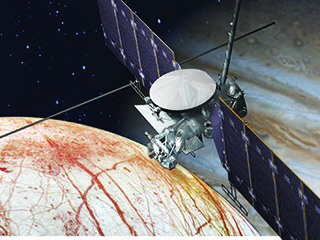
NASA’s Europa Clipper plans to launch in 2023, and will orbit Jupiter in order to carry out flybys of the moon and investigate its structure and contents. Learn more about the mission here!
 Dayvon's Astronomy Blog