A Great Semester

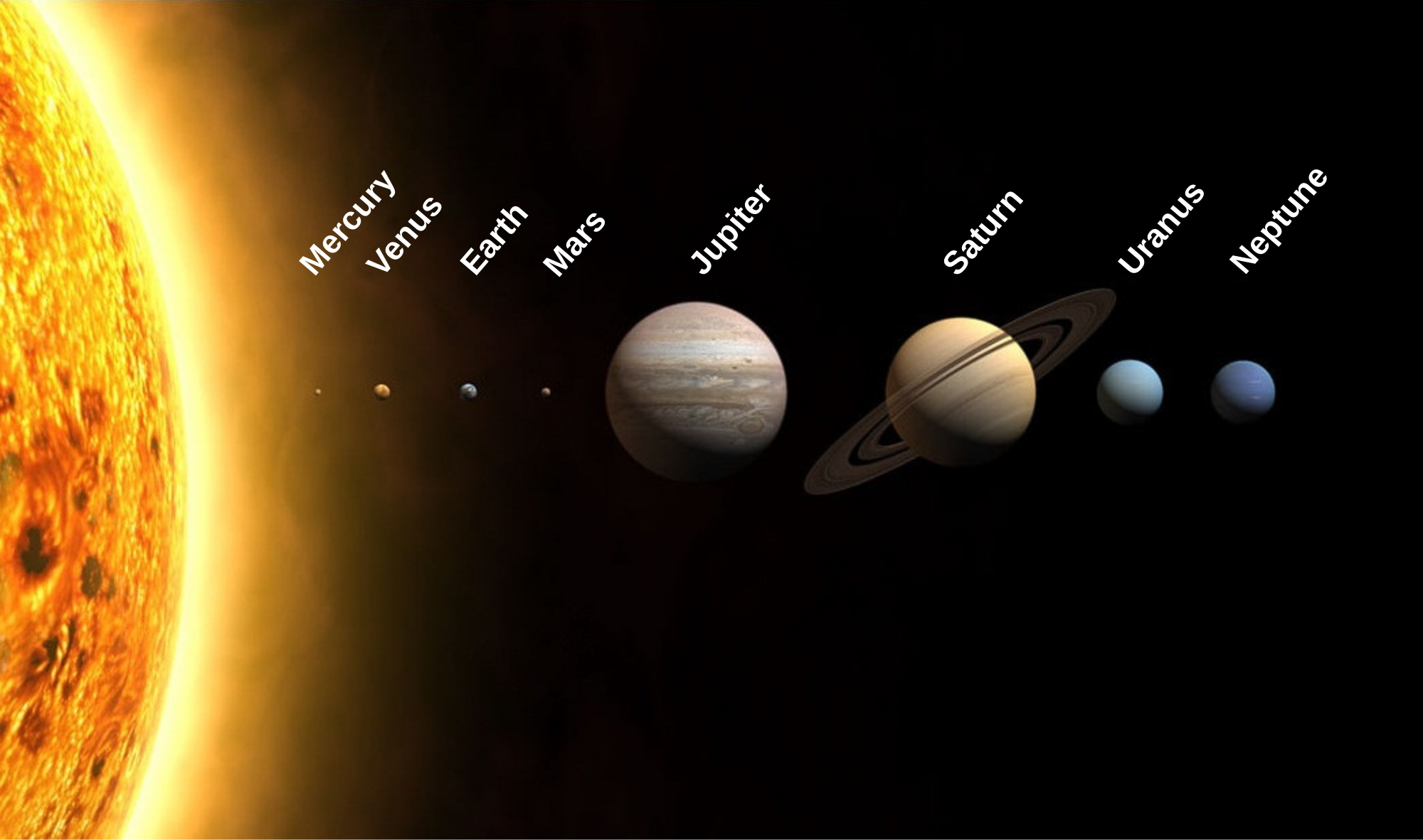
Image result for solar system
Source: Wikipedia – Image of the planets in our solar system (distances are not to scale)

This was a great class, and I’m grateful for all the information I learned. Some concepts were reemphasized since I knew them before taking the course, but I’ve received and retained some new, useful knowledge that I can share with others. I’ve been interested in all things concerning astronomy since I was young, and I take every opportunity I can to learn things about celestial phenomena. Exploring relative sizes of and relative distances between the different things in the solar system during class in addition to researching things that I didn’t even know existed such as the Oort Cloud and different moons was eye opening. Misconceptions of mine, like why the sky is blue during the day and the theory behind the formation of the solar system, have been corrected as well. Many people could benefit from the information presented. I believe that analyzing the cosmic perspective could help a lot of people in a multitude of ways. I knew that Earth was extremely small relative to many other things in the universe, but this class has made me realize just how insignificant we are in the grand scheme of everything.

Europa

Europa, a moon of the planet Jupiter, was discovered in 1610 by Galileo Galilei and Simon Marius. It is a little smaller than Earth’s moon, and it has one of the smoothest surfaces in the solar system. The surface is made up of water ice with long, linear lines fracturing it. The low number of craters and cracks suggest that the surface is no more than 40 million to 90 million years old. There is the possibility that Europa has an iron core and a frozen ocean beneath the crust. No concrete evidence for this ocean exists yet, but previous missions have made it possible to strongly suggest its existence. Tides, which occur because of Jupiter’s stronger gravity on the near side Europa, have been observed, and if the ocean exists these tides could create hydrothermal activity that could make the ocean fit for living things.

Europa
Source: NASA – The trailing hemisphere of Europa. The right image is an enhanced false-color composite.

It takes about 3.5 Earth days for Europa to complete a rotation of its axis. This is also the amount of time it takes for Europa to elliptically orbit Jupiter. The average orbit velocity of this moon is about 46% of Earth’s. The surface temperature is about 110 K on average at the equator and 50 K at the poles. These low temperatures keep the crust solid. Europa’s atmosphere is made up of mostly oxygen as well, however it is very thin. Galileo, the spacecraft, confirmed the presence of an atmosphere when it discovered a weak atmospheric layer of charged particles in 1997. The oxygen in Europa’s atmosphere did not originate there either. Ultraviolet radiation and charged particles smash into Europa’s surface, which splits the water molecules into oxygen and hydrogen atoms that are absorbed into the atmosphere. This ongoing process is referred to as radiolysis.

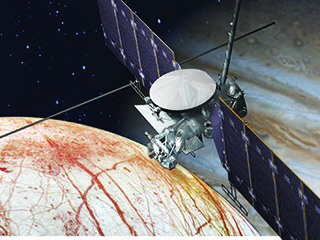
Image result for europa clipper
Source: NASA – Artist conception of Europa Clipper in orbit

NASA’s Europa Clipper plans to launch in 2023, and will orbit Jupiter in order to carry out flybys of the moon and investigate its structure and contents. Learn more about the mission here!

Expanding a Trillion Dollar Industry

Many are familiar with mining on Earth to obtain resources that we use for all sorts of things on the planet. What many don’t know is that this process can be, and most likely will be, expanded beyond the planet. Asteroids contain many of the resources found on Earth since they are basically leftover material from the Solar System’s formation. Asteroid mining is an idea that is currently being explored by scientists and engineers in order to exploit the resources that can be found on these asteroids. Their size and type can vary, and the amount of resources that can be obtained is dependent upon these factors as well as their accessibility.

Image result for asteroid mining
Source: SYFY – Artist conception of asteroid mining

It will take a lot of money (billions) to even begin attempting this project. However, asteroid mining has the potential to be very lucrative as it is estimated that a relatively small asteroid can contain over $20 billion in just platinum. Since many asteroids cross Earth’s orbit during their journey through the Solar System and around the sun, they can be approached using a relatively low amount of fuel from our planet’s orbit. The first missions are loosely projected to be sometime during the 2020s. Planetary Resources is a company that “aims to be the leading provider of resources for people and products in space through its goal of identifying, extracting, and refining resources from near-Earth asteroids” and more information about their plans can be found on their website here.